

Falling behind on your mortgage can quickly feel overwhelming. One missed payment is stressful. Two or three missed payments, followed by letters or calls from your lender, can make it feel like you’re running out of time.
If you’re a Charlotte homeowner looking for a way to stop foreclosure, though, don’t assume that you’ve already run out of options. Depending on where you are in the process, you may still have several ways to catch up, keep the house, or sell it before the foreclosure sale.
The important part is knowing where you stand and acting sooner rather than later.
This guide explains your options if you’re behind on your mortgage in Charlotte, where each one sits in the North Carolina foreclosure process, and when selling the house might make more sense than trying to save it.
Quick Answer
If you’re behind on your mortgage in Charlotte, your main options are usually:
- Work out a repayment plan with your mortgage servicer.
- Apply for a loan modification.
- Request temporary forbearance.
- Sell the house before the foreclosure sale.
Which option makes sense depends on why you’re behind, how far behind you are, whether your income is expected to recover, and how much equity you have in the property.
North Carolina uses a non-judicial, power-of-sale foreclosure process for most mortgages. That means the process can move relatively quickly once it gets underway. The sooner you find out exactly where you are in that process, the more options you may have.
Why Charlotte Homeowners Fall Behind on Their Mortgage
Most people don’t plan on missing their mortgage payments. Usually, something changes that makes the payment harder to keep up with.
Homeowners in Charlotte and Mecklenburg County can fall behind for all kinds of reasons, including:
- Losing a job or having hours reduced.
- A major medical expense or unexpected hospital bill.
- Divorce or separation that changes household income.
- The death of a spouse or co-borrower.
- Higher property taxes or insurance costs.
- An adjustable-rate mortgage resetting to a higher payment.
- Other unexpected expenses that strain the household budget.
Falling behind doesn’t necessarily mean you were irresponsible with your money. Sometimes a single major expense is enough to throw everything off.
What matters now is figuring out what you can realistically do from here.
Option 1: Ask Your Lender About a Loan Modification
A loan modification changes the terms of your existing mortgage to make the payment more manageable over the long term.
Depending on your lender and circumstances, a modification could involve:
- Lowering your interest rate
- Extending the length of the loan
- Moving some missed payments to the back of the loan
- In some cases, reducing the principal balance
A modification is generally worth exploring when your financial situation has changed, but you believe you can afford a lower monthly payment going forward.
How to get started
Call your mortgage servicer and ask for the loss mitigation department. That department typically handles options for borrowers having trouble making payments.
If you would rather not make that call on your own, a HUD-approved housing counselor can help you prepare for it at no cost. In North Carolina, the State Home Foreclosure Prevention Project (1-888-442-8188) can connect you with a counselor in your area.
You may need to provide documents such as:
- Recent pay stubs or other proof of income
- Bank statements
- Tax documents
- A hardship letter explaining what happened
- Information about your monthly expenses
Don’t wait until you’ve gathered every document before contacting your lender. Find out what they need and start the process as soon as you can.
A modification can take weeks or even months to work through, so starting early matters.
When a modification may make sense
Imagine you lost a job several months ago but have recently started working again. You can afford a mortgage payment, but you can’t afford the current payment plus all of the missed payments at once.
A modification could potentially make the monthly payment manageable again while giving you a way to address the amount you’re behind.
If your income isn’t expected to recover, however, lowering the payment may not solve the larger problem. That’s when it’s worth exploring other options.
Option 2: Request Mortgage Forbearance
Forbearance is different from a loan modification because it’s temporary.
Instead of permanently changing your mortgage, forbearance may allow you to temporarily pause or reduce your payments while you work through a short-term financial hardship.
This can make sense if you expect your situation to improve. For example, you might have experienced a temporary job loss and expect to return to work soon.
There are a few important things to understand before agreeing to forbearance:
- The payments you miss generally don’t disappear.
- Your lender may require you to repay the missed amount through a lump-sum payment, repayment plan, or another arrangement.
- You need to request forbearance from your servicer; simply stopping your payments doesn’t automatically put you into a forbearance plan.
- It works best when you have a realistic plan for what happens after the temporary period ends.
Forbearance can give you some breathing room, but it’s not the same thing as having the debt forgiven.
Before agreeing to a plan, make sure you understand exactly what your lender expects you to pay and when.
Option 3: Set Up a Repayment Plan
If you’re only one or two payments behind and your income is stabilizing, a repayment plan may be another possibility.
With a repayment plan, your servicer adds part of what you owe to your regular mortgage payment for a certain period. You gradually catch up while continuing to make your normal payments.
This can work well when the problem was temporary.
For example, you may have missed a paycheck because of a medical procedure or a short period without work, but your normal income has returned. Paying an additional amount each month may be manageable in that situation.
The key question is whether you can actually afford the higher payment.
It’s easy to agree to a repayment plan because you want to save the house. But if the new payment is more than your budget can handle, you could end up further behind a few months from now.
Be realistic about what you can afford.
Option 4: Sell the House Before the Foreclosure Sale
Sometimes the best way to stop foreclosure isn’t to find another way to keep the house. It’s to sell it before the foreclosure sale.
This can be a difficult decision, especially if you’ve lived in the home for years. But if you’re significantly behind on your mortgage and don’t expect your financial situation to improve soon, selling may give you more control over what happens next.
The biggest factor is timing.
If you sell the house before the foreclosure sale, you can generally pay off the mortgage from the sale proceeds. If there is money left over after paying the mortgage and other closing costs, that remaining equity may go to you.
Once the property reaches foreclosure, you have much less control over the outcome.
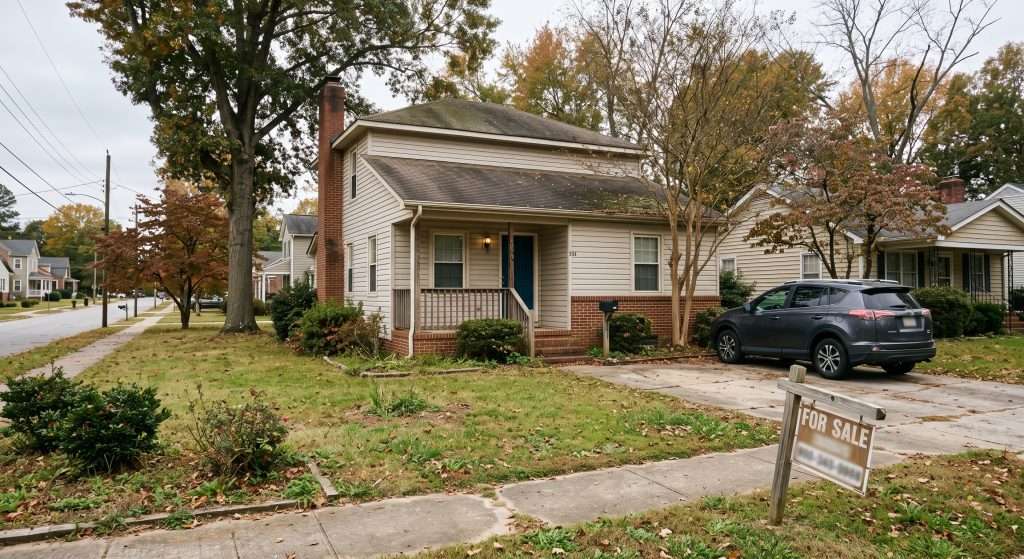
What if you don’t have much time?
This is where a traditional home sale can become difficult.
Listing with an agent means preparing the property, putting it on the market, scheduling showings, waiting for an offer, negotiating, going through inspections and other contingencies, and eventually getting to closing.
That process can take 60 to 90 days or longer.
If your foreclosure sale is already scheduled, you may not have that much time.
A direct cash sale can sometimes close much faster because it skips the traditional listing process. Depending on the situation, a cash buyer may be able to close in as little as 7 to 14 days.
That doesn’t mean selling to a cash buyer is automatically the right choice. It simply gives you another option when time becomes the biggest problem.
If you’re considering selling, the first step can be as simple as finding out what the house could realistically sell for and how much you’d have left after paying off the mortgage.
Where This Sits in the North Carolina Foreclosure Process
North Carolina generally uses a non-judicial, power-of-sale foreclosure process for most mortgages, which means it can move faster than a court-supervised foreclosure once it gets underway. Knowing which stage you are in tells you how much room you still have.
The short version: for many loans, federal servicing rules generally prevent a servicer from starting foreclosure until you are at least 120 days delinquent. Before a case can be filed, your servicer must also mail you a pre-foreclosure notice at least 45 days ahead of time under North Carolina law (N.C.G.S. § 45-102). That notice itemizes exactly what you owe to bring the loan current and points you to help.
Only after that does the lender’s attorney or substitute trustee file a Notice of Hearing with the Clerk of Superior Court — for a Charlotte property, that generally means Mecklenburg County. A hearing follows, and if the foreclosure is authorized, the property is posted for a public sale at least 20 days later. Even after the auction, North Carolina allows a 10-day upset bid period in which another buyer can bid higher.
Almost everything in this article happens in the window before that Notice of Hearing is filed. That window is usually longer than homeowners assume, but it does close.

Our full North Carolina foreclosure timeline walks through each stage in detail, including how long each one typically takes and which options close at each step.
Which Option Makes the Most Sense?
There’s no single answer for every homeowner.
Here’s a simple way to think about the options:
| Option | May make sense if… | Typical timing | Keep the house? |
|---|---|---|---|
| Repayment plan | You’re only a payment or two behind, and your income is stabilizing | Weeks to set up | Yes |
| Loan modification | Your hardship is longer-term, but you want to stay | Often 30–90 days | Yes |
| Forbearance | Your financial problem is temporary | Can begin relatively quickly | Yes, if you resolve the payments afterward |
| Sell before foreclosure | You’re significantly behind and don’t expect your income to recover soon | Potentially as fast as 7–14 days with a cash buyer | No, but you control the sale |
These aren’t the only possibilities, and your lender may offer other programs based on your loan.
The goal isn’t to pick the option that sounds best on paper. It’s to figure out which option actually fits your financial situation.
What to Do This Week If You’re Behind
If you’re worried about foreclosure, don’t spend the next few weeks trying to figure everything out on your own.
Start with these steps:
- Find your most recent mortgage statement and determine exactly how many payments you’re behind.
- Call your mortgage servicer and ask what stage your loan is currently in.
- Ask about the loss mitigation options available for your loan.
- Check Mecklenburg County Clerk of Superior Court records to see whether a Notice of Hearing has been filed.
- Gather your income and financial documents in case you apply for a modification or forbearance.
- If a foreclosure sale has already been scheduled, find out exactly how much time you have left.
- If keeping the house no longer looks realistic, get an estimate of what you could net by selling it.
Be cautious of anyone who demands an upfront fee in exchange for promising to stop your foreclosure.
You don’t have to make every decision this week. But you should know where you stand.
Frequently Asked Questions
How many mortgage payments can I miss before foreclosure starts in North Carolina?
For many mortgages, federal servicing rules generally prevent a servicer from starting the foreclosure process until the loan is at least 120 days delinquent. However, the exact timeline can vary by loan and other circumstances.
More importantly, don’t use 120 days as a reason to wait.
If you’ve already missed a payment, contact your servicer and ask what options are available. The earlier you start the conversation, the more time you may have to work something out.
How do I find out how far behind I am and whether foreclosure has started?
Start with your most recent mortgage statement and a call to your servicer. Ask for the exact reinstatement amount — the total needed to bring the loan current today — and ask whether a pre-foreclosure notice has already been sent.
To find out whether a case has actually been filed, check the Mecklenburg County Clerk of Superior Court records for a Notice of Hearing on your property. Foreclosure proceedings are public record, so this is something you can verify rather than guess at.
Will I still owe money if my house goes through foreclosure in North Carolina?
Possibly.
Depending on the circumstances, North Carolina law may allow a lender to pursue a deficiency judgment for some or all of the amount remaining if the foreclosure sale doesn’t cover the debt.
Because deficiency rules can depend on the type of loan and other factors, it’s worth getting advice specific to your situation.
North Carolina law does offer homeowners some protection here. If you can show that the home’s fair market value at the time of the sale was higher than the foreclosure sale price, you may be entitled to an offset that reduces the deficiency judgment, and if the property was worth the full amount of the debt, you may not owe a deficiency at all.
Selling the property before foreclosure can sometimes put you in a better position because you control the sale price and how you use the proceeds.
Does mortgage forbearance hurt my credit?
It depends on your specific forbearance agreement and how your servicer reports the payments.
Before entering a forbearance plan, ask your servicer how the arrangement will be reported to the credit bureaus and what happens to the missed payments afterward.
Don’t assume that “forbearance” automatically means your credit won’t be affected.
What if I don’t have any equity in my house?
If you owe more on the mortgage than the house is worth, selling the property can be more complicated.
A normal sale may not generate enough money to pay off the mortgage and closing costs. In that situation, you should discuss options such as a short sale or deed-in-lieu of foreclosure with your lender.
Even if you don’t think you have equity, it can still be useful to find out exactly where you stand before making a decision.
What happens at the foreclosure hearing in Mecklenburg County?
Under N.C.G.S. § 45-21.16, the trustee files a Notice of Hearing with the Clerk of Superior Court in the county where the property sits, and you must be served at least 10 days before the hearing. The clerk authorizes a sale only after finding a valid debt, a default, a right to foreclose under the deed of trust, proper notice, and, for a home loan, that the 45-day pre-foreclosure notice was sent and the waiting periods have run.
You may appear and contest that evidence, and the notice must say that free legal help may be available through Legal Aid of North Carolina. If you would rather sell than fight, our Charlotte foreclosure page explains a pre-sale cash closing.
Can the foreclosure hearing be postponed while I work on a loan modification?
Sometimes. If you live in the house as your principal residence, N.C.G.S. § 45-21.16C requires the clerk to ask what your servicer has done to resolve the default, and to continue the hearing — to a fixed date no more than 60 days out — when there is good cause to believe more time or a workout such as forbearance or a loan modification is reasonably likely to resolve the delinquency. It is not automatic, so bring proof of your application and any correspondence with the servicer.
Keep in mind this applies to your mortgage lender’s case only. A Mecklenburg County tax foreclosure or an HOA lien foreclosure runs on its own track.
Does my lender have to let me reinstate the loan?
North Carolina’s foreclosure statute does not create a blanket right to reinstate; whether you can cure the default depends on your loan documents. What the statute does require is disclosure. The Notice of Hearing must state any right you have to pay the debt or cure the default if your loan permits it, and it must confirm that you were mailed an itemized statement of the principal, interest and fees claimed due within 30 days of the notice (§ 45-21.16(c)).
The earlier 45-day pre-foreclosure notice under § 45-102 must also itemize every past-due amount and charge needed to bring the loan current. Get that reinstatement figure in writing before deciding whether to catch up or sell.
Can I still sell my Charlotte house after the Notice of Hearing is filed?
Yes. The Notice of Hearing itself must state that skipping the hearing does not affect your right to pay the debt and prevent the sale (§ 45-21.16(c)(7)), and paying the loan off through a sale is one way to do that. Even after an auction, the parties’ rights are not fixed until the 10-day upset-bid period under § 45-21.27 passes with no higher bid — but do not plan around that window. The sale date is the real deadline.
A closing has to fund before that date, which is why a cash sale is often the practical route when time is short. See how our process works and what we buy in Charlotte.
The Bottom Line
If you’re behind on your mortgage in Charlotte, don’t wait until the foreclosure sale is right around the corner before figuring out your options.
You may be able to catch up through a repayment plan, change your loan terms, use temporary forbearance, or sell the property before the foreclosure process goes any further.
The right answer depends on your situation.
And if keeping the house no longer makes financial sense, selling doesn’t have to mean giving up everything you’ve put into it. If you have equity, selling before foreclosure may let you pay off the mortgage and keep whatever is left, while also giving you more control over the timing.
If you’re considering selling, Cardinal House Buyers can give you a straightforward cash offer based on the house’s current condition. You don’t have to commit to find out what your options look like.
We’re happy to walk through the numbers with you and help you understand what selling now could look like compared with waiting for the foreclosure process to continue.
This article is for general informational purposes only and is not legal or financial advice. Foreclosure laws and timelines can vary based on your specific loan, lender, and circumstances. For advice about your particular situation, speak with a licensed North Carolina attorney or a HUD-approved housing counselor.
If selling turns out to be your best option and the calendar is tight, here is how we can help you sell your house fast in Charlotte before a foreclosure sale.


